 Fundación Fraunhofer Spain Research
Fraunhofer CAT opens its doors to Erasmus Mundus Master students
Fraunhofer CAT is committed to fostering young talent, promoting knowledge transfer, and strengthening international collaboration. The Erasmus Mundus programme provides an excellent framework to support these goals. For readers who may be unfamiliar with it, Erasmus Mundus is a well-known cooperation and mobility programme in higher education organised by the European Commission under the broader Erasmus+ initiative. Its objective is to enhance the quality of European higher education, promote the European Union as a global centre of excellence in learning, and encourage intercultural understanding through collaboration with partner countries. In addition, the programme contributes to the development of higher education systems in countries outside the EU.
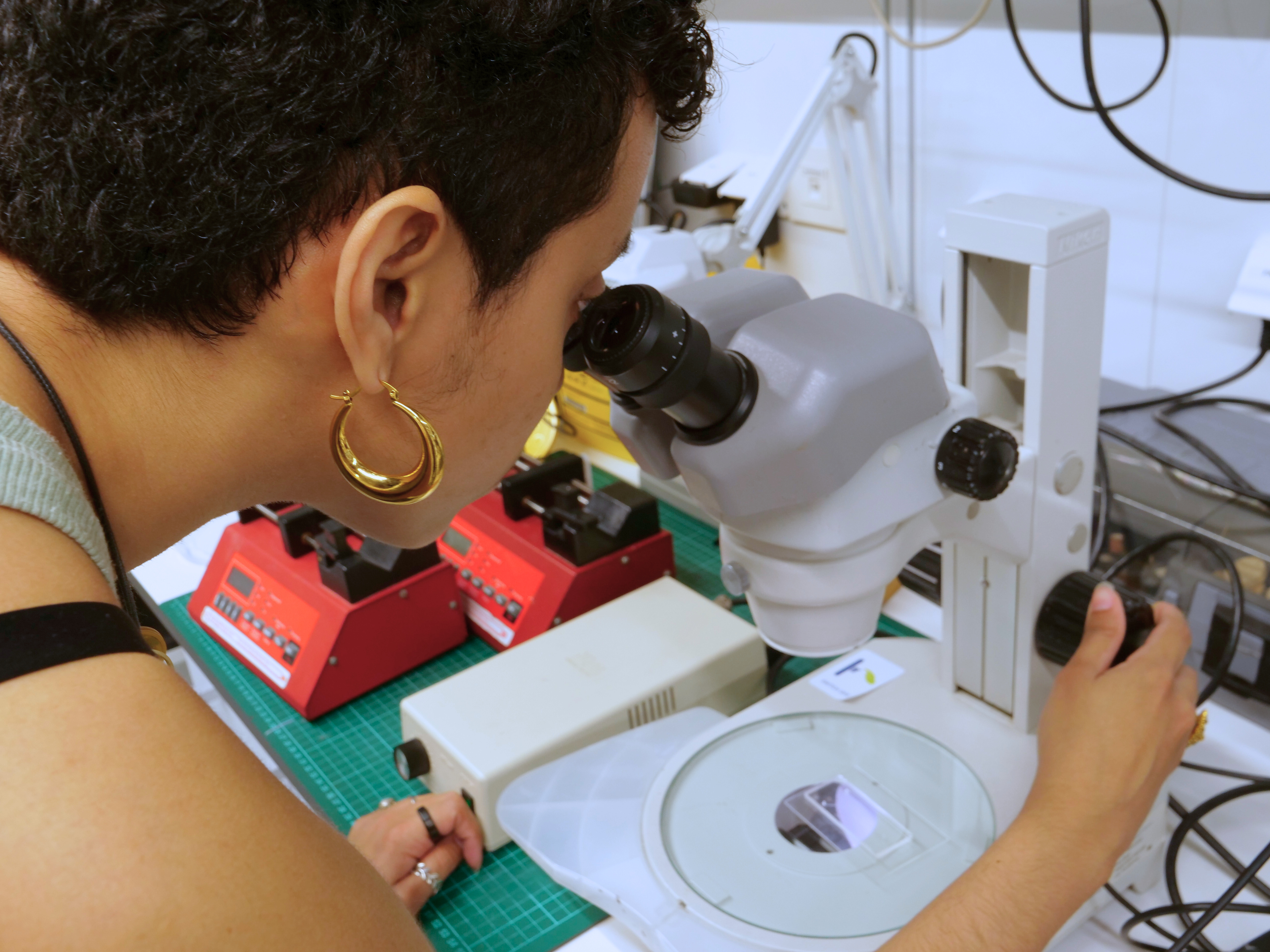
Within this context, the Fraunhofer Center for Theragnostics (Fraunhofer CAT) organized a three-hour hands-on workshop on nanoscience and nanotechnology, focusing on the fundamental principles of microfluidics, for five Master’s students from Katholieke Universiteit Leuven. The participating students came from diverse academic backgrounds, including nanotechnology, bioengineering, and biology.
The workshop began with an introduction to the Fraunhofer ecosystem and the mission of Fraunhofer CAT, presented by Dr Maria José López, Senior Technician at Fraunhofer CAT. She provided an overview of the Fraunhofer model of applied research and highlighted how interdisciplinary collaboration and technology transfer play a central role in the institute’s activities.
Students were then introduced to the fundamentals of microfluidics, a technology that manipulates small volumes of fluids within considerably narrow channels. Working at a reduced scale allows researchers to use minimal sample volumes while maintaining precise control over experimental conditions, including the formation of droplets or vesicles that can be used to efficiently encapsulate drugs.
In addition, microfluidics allows researchers to study cells at an individual level and to investigate transport phenomena. For example, in the field of »organ-on-chip« systems, which replicate the functional units of human organs, microfluidics helps to study cellular responses to drugs under conditions that more closely resemble the human body.
Through simple yet highly visual experiments, students explored laminar flow in microchannels, observed diffusion-driven mixing between co-flowing liquids, and compared the behavior of single-phase flows (water–water) with multiphase flows (water–oil). The workshop provided participants with both theoretical insights and hands-on experience, illustrating how microfluidic technologies are shaping modern research in nanoscience, biotechnology, and medicine "Activities like this workshop show how important and enriching sharing our knowledge with students from different disciplines and cultures is." said Dr Maria José López, Senior Technician at Fraunhofer CAT.
More information on Erasmus: EMM NANO. (2026). Erasmus Mundus. What is Erasmus Mundus? https://www.emm-nano.org/what-is-erasmus-mundus/