 Fundación Fraunhofer Spain Research
Fraunhofer Spain Research present at the 30th International Conference on Miniaturized Systems for Chemistry and Life Sciences - MicroTAS
MicroTAS is an important international conference that brings together researchers and industry professionals to share advances in small-scale technologies, including microfluidics, lab-on-a-chip and organ-on-a-chip systems. At the conference, held from 18 to 22 October, our Deputy Director, Prof. Dr. Elena Martínez, gave a presentation titled “Hydrogel-Based Microphysiological Systems for Modeling Tissue Function and Disease”, in which she presented our research using hydrogel-based models to study cancer and T cells, which help the immune system fight tumours.
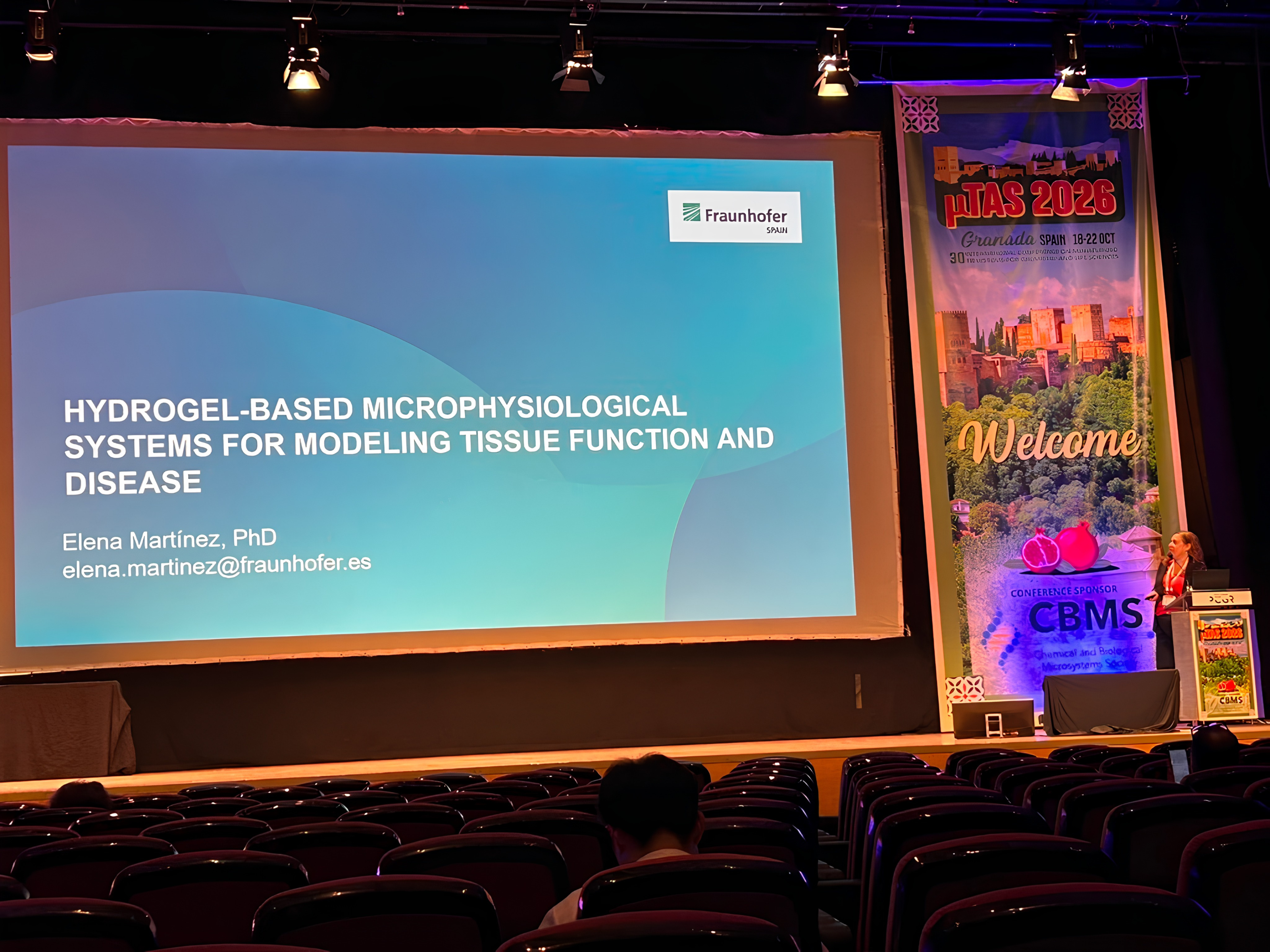
First of all, Dr Martínez explained that to understand how the T cells migrate within cancer microenvironments, it is crucial that our researchers reproduce in vitro (in the laboratory) what happens in vivo (in living organisms). How do they reach this? One of the answers is to use advanced in vitro models such as organ-on-a-chip systems.
In this context, Fraunhofer CAT researchers compare healthy tissue models with models of early and advanced colorectal cancer to study how T cell infiltration changes as the disease progresses. As the tumour develops, it changes the environment making it harder for T cells to enter the tissue and fight the tumour. Our researchers also found that a healthy endothelium prevents cancer cell extravasation, whereas increased inflammation of the barrier increases its permeability, allowing cancer cells or CTCs (circulating tumour cells) to spread and potentially form metastasis in other tissues. In this sense, understanding this process and developing these chip-based models could help improve our understanding of cancer progression and the mechanisms of metastasis and, in the future, support the development of personalised therapies for patients, explained Dr. Martínez.
Alongside microfluidics, lab-on-a-chip and organ-on-a-chip systems, MicroTAS covered advances in wearable devices, microfabrication, 3D printing and nanotechnology, with applications in chemistry, the life sciences, medicine and the environment. These topics connect with our research at Fraunhofer Spain Research. For us, taking part in MicroTAS was a valuable opportunity to share knowledge with international experts and build connections with colleagues across academia and industry.